Why deconstruction and Bible study feel incompatible
For a lot of people, "Bible study" was where the certainty got installed — so opening a Bible app mid-deconstruction feels like walking back into the building you just left. But the problem was never studying the text. It was studying it in a room where only one reading was allowed. Deconstruction, at its healthiest, isn't the end of Bible study; it's the moment you notice the other nineteen centuries of it.
What a deconstruction-shaped Bible app looks like
The Long Table was built by a pastor for exactly this season. It has a full Bible built in — read it, tap any verse, send it to the table. It answers the questions churches flinch at: hell, predestination, women in ministry, purity culture, doubt itself. Every question gets eight answers from eight real traditions — including a fair, recognizable version of the evangelicalism you may be leaving, because setting down a cartoon doesn't heal anyone. There is no verdict, ever. No streaks, no scores, no guilt mechanics. No account; your name, background, and journal never leave your phone. And when the traditions disagree, the app doesn't hide it — it charts exactly where the split runs, because the disagreement is the honest part.
You don't have to choose between the reading you got and the door
The whole app exists because of one observation: people deconstructing usually think their options are the interpretation they grew up with, or leaving. There was always a third option — the rest of the church, twenty centuries of it, arguing faithfully with the same texts. Historians, mystics, liberationists, the Black church, the Eastern church, the first Jewish readers. The Long Table just pulls up the chairs.
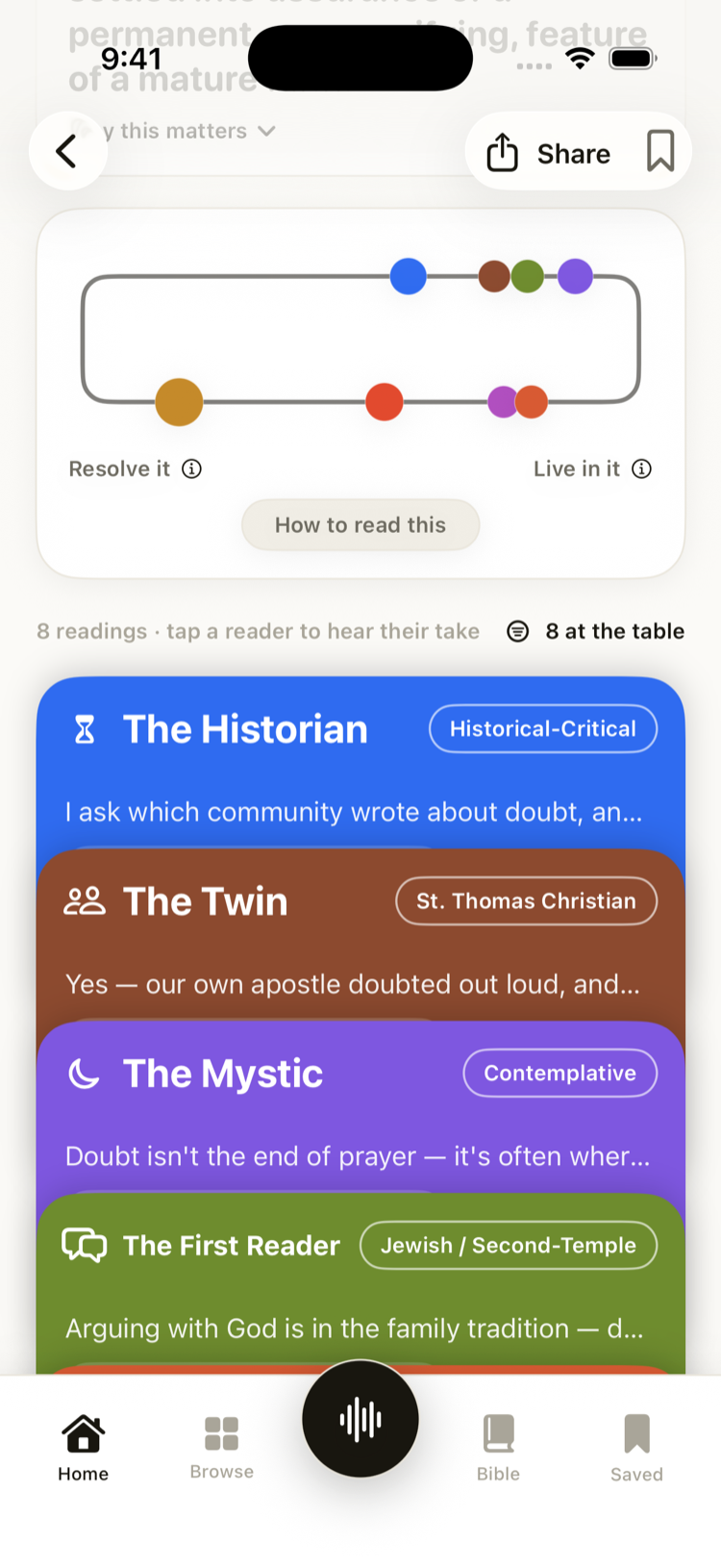
How to explore this at the table
- Download the app — there's no account and no onboarding quiz about your beliefs. Pick the readers you want at your table; you can change them anytime.
- Start with the question that started your deconstruction. Hell, Romans 9, Ephesians 5, "why does God allow suffering" — the table doesn't flinch.
- Read the tradition you're leaving at its strongest, next to the ones you were never shown. Both matter; one without the other is just a new echo chamber.
- Use follow-ups to push back. "But what about—" is a fully supported feature.
- Keep your reactions in the private journal. Where you land — including nowhere yet — is yours, on your phone, and no one else's business.
Bring this question to the table.
Free on iPhone · 4 readers free · Plus seats all 8 with a 7-day free trial · No account, no verdict.