The short, honest answer
Denominations differ less over what the Bible says than over how to weigh what it says — which texts interpret which, what counts as the center, and what sits alongside Scripture as a guide. Evangelical traditions weigh the plain sense and personal salvation heavily. Catholic and Orthodox traditions read with the accumulated church — creeds, councils, liturgy — as the interpretive community. Historical-critical readers ask what the text meant to its first audience before asking anything else. Liberation and womanist traditions test every reading against what it does to the poorest person in the room. None of these methods is lazy; each is answering a different first question.
What the traditions actually say
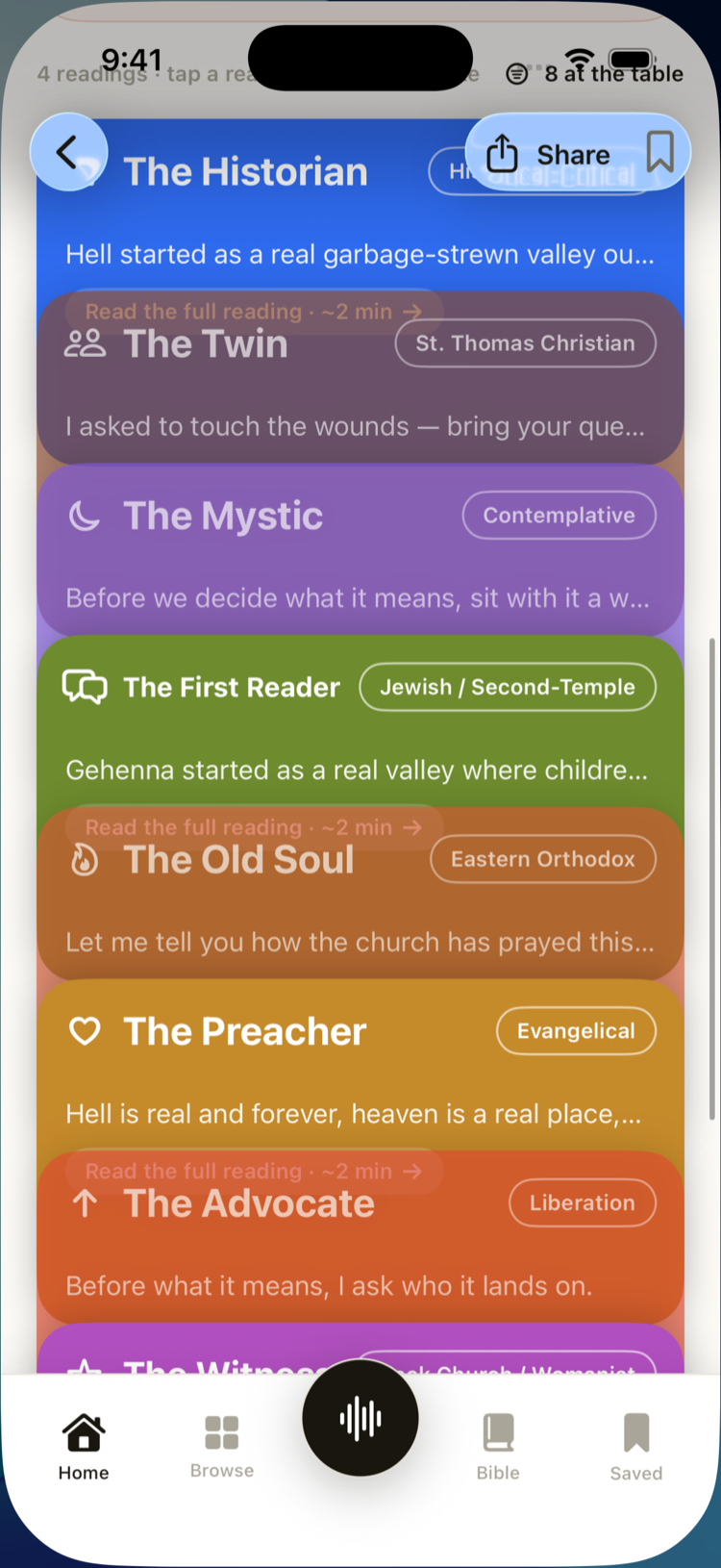
This is the whole premise of The Long Table: instead of one denomination's answer, you get eight interpretive traditions seated at the same table, each in its own voice, each at its strongest. The Historian, The Twin, The Mystic, The First Reader, The Old Soul, The Preacher, The Advocate, and The Witness — every reader is a whole way of reading, not a straw man. Ask one question and you watch the methods diverge in real time; the fault-line chart shows where the split runs, and the 'why this matters' note tells you what's actually at stake in it.
Where the fault line runs
On most questions the deepest divide traces back to authority: Scripture alone, Scripture-with-tradition, Scripture-through-history, or Scripture-tested-by-its-fruit. Once you can name which authority-instinct a reading comes from, other people's interpretations stop sounding like bad faith and start sounding like a different first question.
How to explore this at the table
- Download The Long Table and ask your first question — or start with the Question of the Week, which is free for everyone including a rotating guest reader.
- Read the eight one-line takes. You now know more about the actual spread of Christian interpretation than most Sunday classes cover in a semester.
- Open the fault-line chart and tap 'How to read this.' It explains the axis in plain English — no seminary vocabulary required.
- Raise any reader's card for the full reading, with primary sources quoted so you can check the work.
- Repeat with the question you actually came with. Four readers are free forever; Plus seats all eight with a 7-day free trial.
Bring this question to the table.
Free on iPhone · 4 readers free · Plus seats all 8 with a 7-day free trial · No account, no verdict.