The short, honest answer
It depends on who you ask — and that's not a dodge, it's the actual shape of church history. Some traditions treat doubt as a temporary detour: a stop on the way back to settled assurance, something to resolve with better answers or deeper trust. Others treat doubt as a permanent, even purifying feature of mature faith — less a crisis than a discipline. Thomas asked to touch the wounds and wasn't turned away. The Psalms are full of accusations aimed at heaven. "I believe; help my unbelief" made it into the Gospel of Mark without an apology attached.
What the traditions actually say
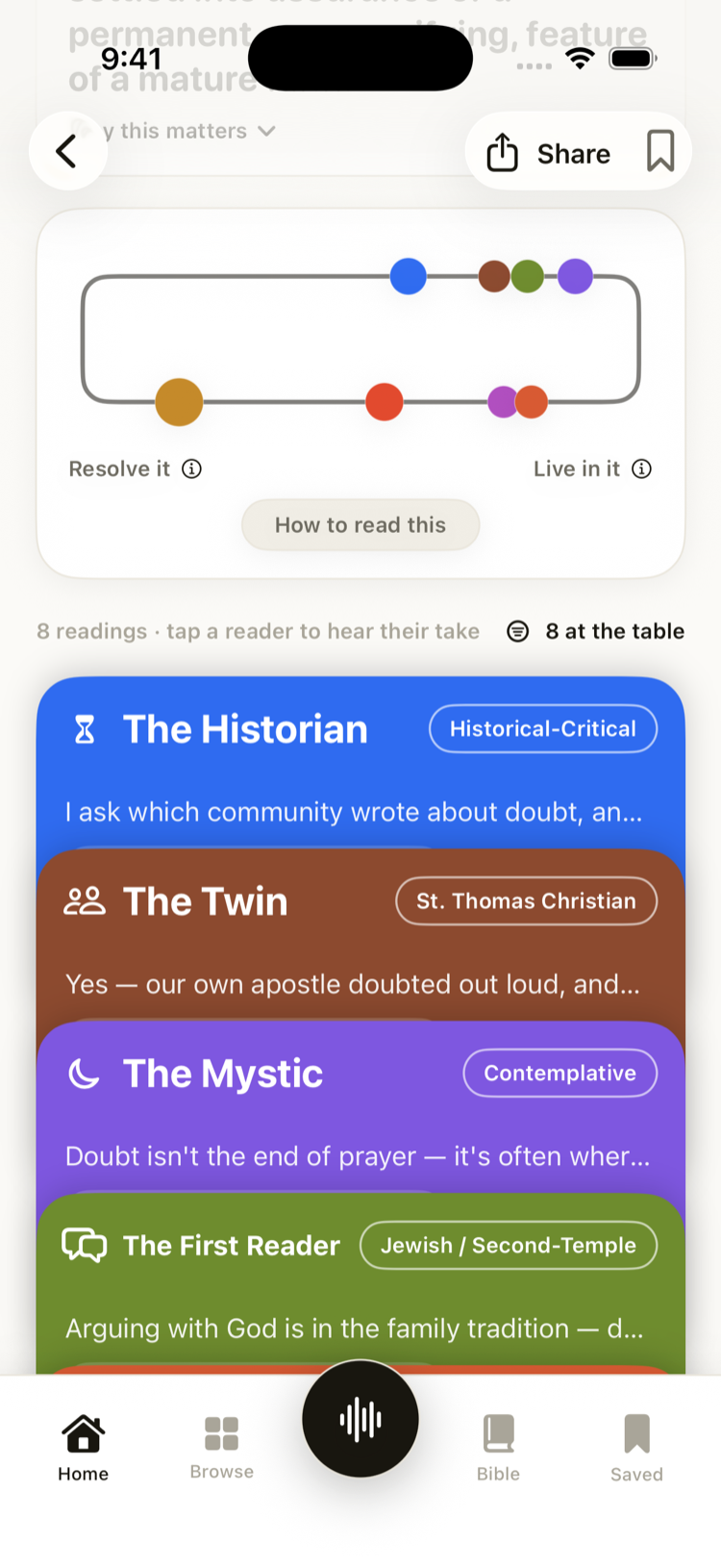
Ask "Is it okay to doubt?" at The Long Table and eight readers answer in their own voices. The Historian asks which biblical communities wrote about doubt and why their answers differ. The Mystic will tell you doubt isn't the end of prayer — it's often where the honest kind starts; the contemplative tradition mapped the "dark night" centuries ago. The Preacher takes doubt seriously as a weight — and urges you not to camp there alone. The First Reader points out that arguing with God is in the family tradition: Abraham, Job, and Jacob all did it by name. The Witness notes that for people who suffered most, crying out to God was the only honest prayer available — and it was still prayer. Same question, eight readings, and a chart showing exactly where they split: is doubt something you resolve, or something you live in?
Where the fault line runs
The deep divide isn't "doubt is good" versus "doubt is bad." It's whether faith is primarily assent (so doubt threatens it) or primarily trust-in-relationship (so doubt can live inside it). Once you see that fault line, most of the shouting about doubt makes more sense — and gets quieter.
How to explore this at the table
- Open The Long Table and type the question exactly as it lives in your head — "Is it okay to doubt?" or "Is doubt a sin?" Both work; nothing is off the table.
- Watch the table seat. Each reader gives a one-line take first — you'll see the disagreement at a glance before you read a word of depth.
- Check the fault-line chart. For this question it typically runs from "Resolve it" to "Live in it." Tap any dot to hear that reader's full case.
- Open the readers that surprise you — especially the tradition you grew up in. It may be kinder on doubt than its Sunday-morning version was.
- Mark where you land — or stay undecided — in the private journal. Undecided is a real answer here.
Bring this question to the table.
Free on iPhone · 4 readers free · Plus seats all 8 with a 7-day free trial · No account, no verdict.