The short, honest answer
The Bible's language about final judgment is real, vivid, and less uniform than you may have been told. Gehenna, Hades, the lake of fire, "eternal punishment," "destruction," and "all things reconciled" all appear in the text — and serious Christians have built serious readings on each. Eternal conscious punishment is one historic position. Annihilation (the unrepentant cease to exist) is another, with advocates from the early church to modern evangelical scholars. Universal reconciliation — the hope that judgment purifies rather than ends — goes back at least to Gregory of Nyssa in the fourth century. And several traditions insist hell's first address is here and now, in the systems people build against each other.
What the traditions actually say
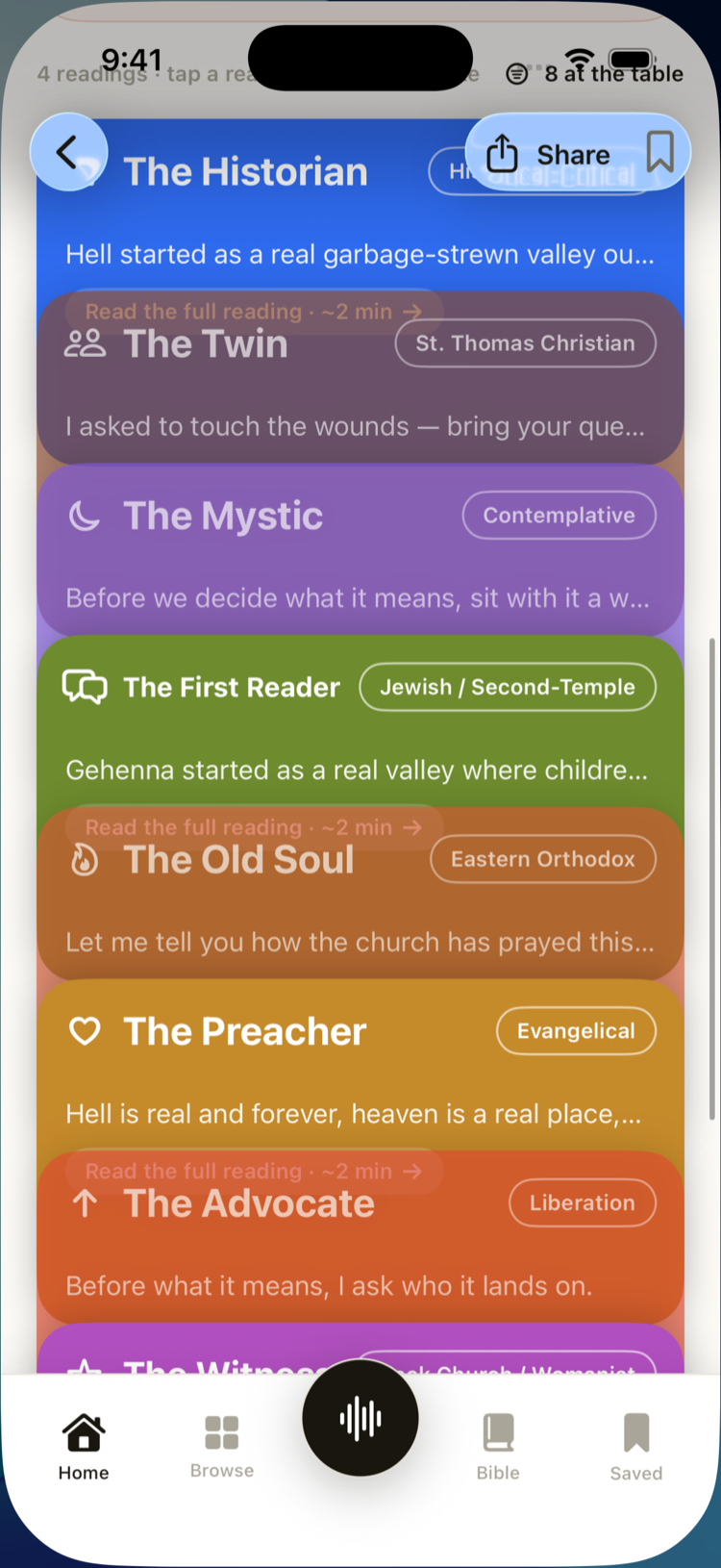
Bring "Heaven and hell" to the table and the disagreement is immediate and honest. The Preacher preaches the urgency: judgment is real, the stakes are eternal, and the altar call exists because love warns. The Historian sorts out how Gehenna — an actual valley outside Jerusalem — became a symbol, and what first-century Jews heard in it. The Old Soul reads judgment through the unquenchable love of God: the same fire experienced differently depending on what you've become. The Witness reads from the underside of history: enslaved Christians knew slaveholding religion was "devils dressed in angels' robes" — and named hell in the present tense. The First Reader points out the Hebrew Bible barely maps the afterlife at all, and asks why later readers needed it so precisely.
Where the fault line runs
The sharpest split isn't over whether judgment exists — every chair takes it seriously. It's over what judgment is for: punishment that ends in separation, or purification that ends in restoration. Where a tradition lands there predicts almost everything else it says about hell.
How to explore this at the table
- Ask the table directly — "Is hell forever?", "What happens after death?", or tap a passage like Matthew 25 or Revelation 20 in the built-in Bible and send it.
- Read the one-line takes first. You'll see eternal-punishment, annihilation, and universal-hope readings seated at the same table — likely for the first time.
- Open the fault-line chart to see where each tradition lands, then tap the two farthest-apart dots and read both full cases back to back.
- Use a follow-up — "But what about the lake of fire?" — and the readers answer in light of what was already said.
- When you're done, mark where you land in the private journal. Or don't. The table holds the question either way.
Bring this question to the table.
Free on iPhone · 4 readers free · Plus seats all 8 with a 7-day free trial · No account, no verdict.