The short, honest answer
Ephesians 5:22 doesn't stand alone. In Greek, the sentence "wives, submit" doesn't even contain its own verb — it borrows it from verse 21: "submit to one another out of reverence for Christ." Everything after flows from that hinge, and what a tradition does with verse 21 predicts everything it says about verse 22. Complementarian readings hear an ordered harmony: distinct roles, the husband's role defined by self-giving love, not command. Egalitarian and liberationist readings hear a first-century household code being bent — visibly, on the page — toward mutuality, and ask why we'd freeze the bend instead of following it. Historians add that Paul's version is strange precisely where it differs from Aristotle's: the husband is never told to rule, only to love like a crucified man.
What the traditions actually say
The Preacher gives the complementarian reading its real warmth — headship as costly responsibility, never license — because that's what its best preachers actually say. The Historian sets the passage beside the standard Greco-Roman household codes so you can see exactly what's conventional and what's subversive. The Advocate reads it with the women for whom "submit" was made a cage, and insists the gospel test of any reading is what it does to the vulnerable. The Twin — from a church older than Christendom's empires — asks what the household codes sound like in a house where the gospel arrived without Caesar attached. The Witness remembers communities where this text was quoted to sanctify real harm, and reads it anyway, refusing to hand it over to its abusers.
Where the fault line runs
The split is whether verse 21's "submit to one another" is the rule that verse 22 illustrates, or a general preface that verse 22 makes specific. Grammatically small; theologically enormous. The chart shows who lands where — and the full readings show what each side is protecting.
How to explore this at the table
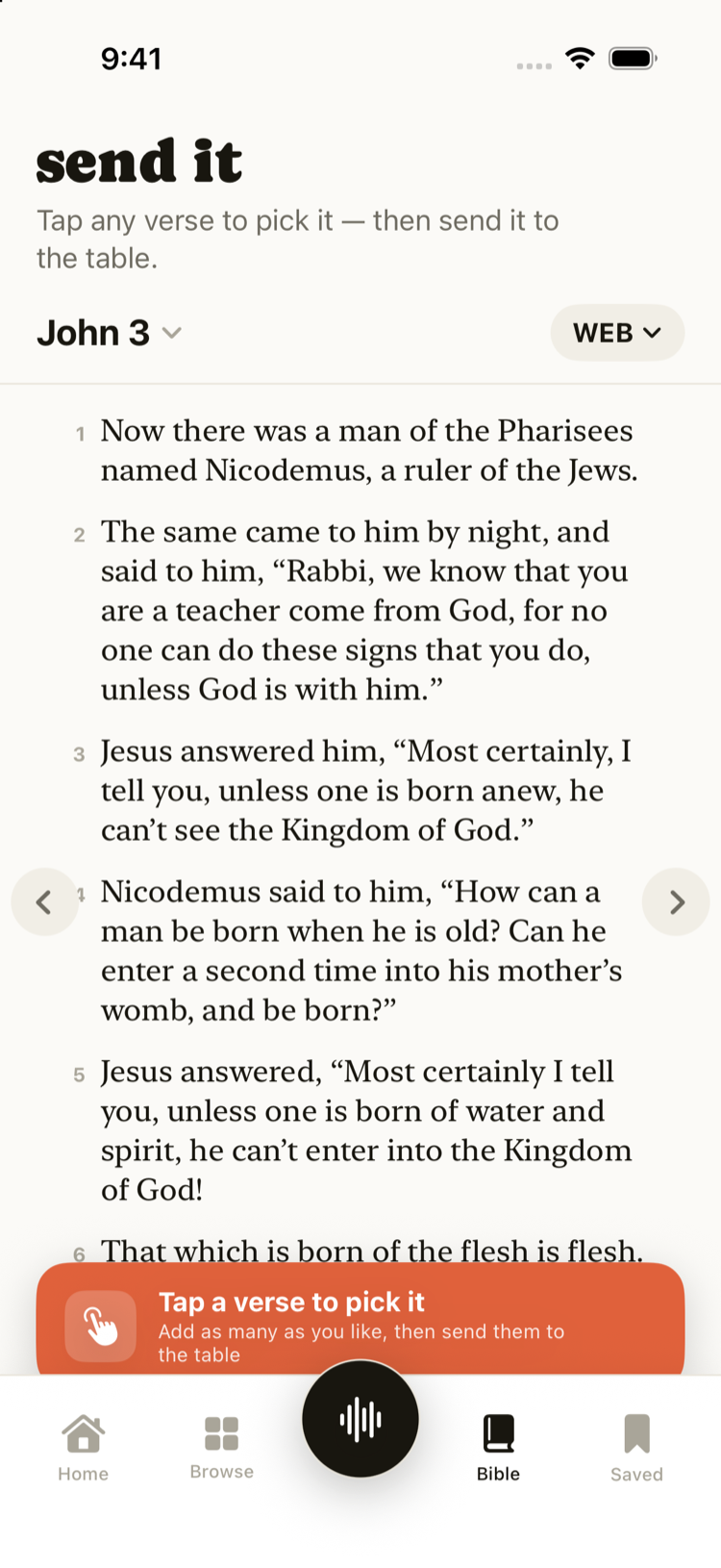
- Tap Ephesians 5 in the built-in Bible — the text is right there, verbatim — select verses 21–33, and send them to the table.
- Read the one-line takes. Notice no reader is asked to pretend the hard verse isn't there.
- Open the two readings farthest apart on the chart and read both cases in full. Each is presented at its strongest.
- Ask the follow-up you actually carry — "Is mutual submission possible?" or "What does this mean if my marriage was hurt by it?"
- Your reflections stay in the private journal, on your phone. Some questions deserve a room with the door closed.
Bring this question to the table.
Free on iPhone · 4 readers free · Plus seats all 8 with a 7-day free trial · No account, no verdict.