The short, honest answer
The New Testament contains both restriction texts and leadership texts, and every tradition has to decide which interprets which. On one side: "I do not permit a woman to teach" (1 Timothy 2:12) and the household codes. On the other: Junia, "outstanding among the apostles" (Romans 16:7); Phoebe the deacon who carried the letter to Rome; Priscilla teaching Apollos; Deborah judging Israel; the daughters who "shall prophesy" in Joel and Acts; and Mary Magdalene, the first person sent to announce the resurrection. Neither list is obscure. The disagreement is about which list sets the rule and which gets read as the exception.
What the traditions actually say
At the table, The Preacher gives the complementarian case at its strongest — created order, not cultural accident — because a caricature would help no one. The Historian reconstructs what women actually did in the earliest assemblies, and why 1 Timothy's situation in Ephesus matters for what it commands. The Advocate reads the same letters through Galatians 3:28 — "no longer male and female" — and asks who benefits when the restriction texts win. The Witness carries the long history of Black church mothers who preached whether or not anyone ordained them. The First Reader sets the household codes beside their Greco-Roman parallels, where you can see what the New Testament writers changed.
Where the fault line runs
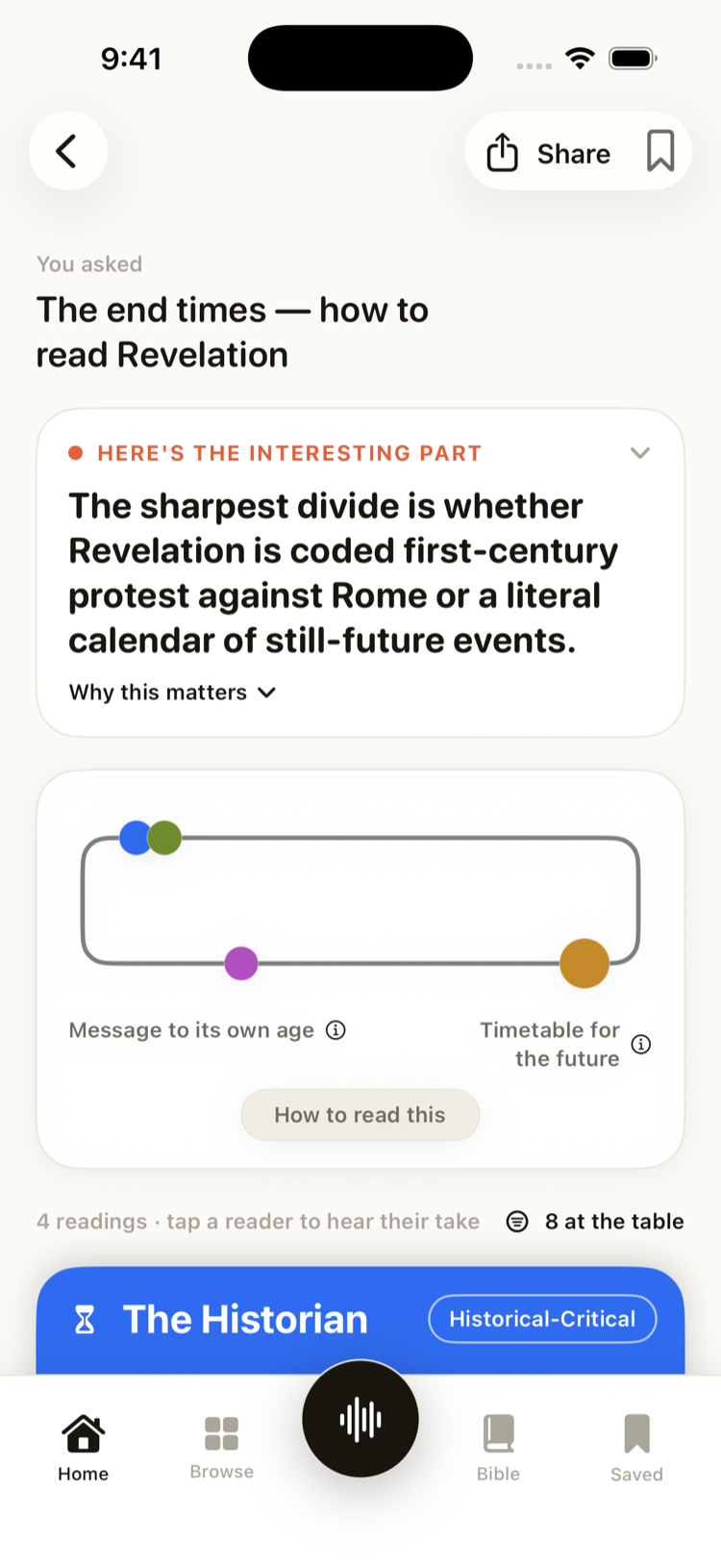
The divide isn't "takes the Bible seriously" versus "doesn't." Both sides do. The fault line is whether the restriction texts are creation-order commands for all time or situational instructions inside a trajectory that points somewhere freer. The chart makes that visible in about four seconds.
How to explore this at the table
- Ask the question in your own words — "Can women be pastors?", "Should women preach?" — or tap 1 Timothy 2 or Romans 16 in the built-in Bible and send it to the table.
- Read the one-line takes to see the spread, then open The Preacher and The Advocate back to back — the two strongest opposing cases, each given its best voice.
- Check the fault-line chart to see which traditions cluster and which stand alone on this one.
- Follow up with the verse that's always bothered you. The readers answer in context of the conversation you're already having.
- Mark where you land privately — especially useful if where you land isn't where your church does.
Bring this question to the table.
Free on iPhone · 4 readers free · Plus seats all 8 with a 7-day free trial · No account, no verdict.